
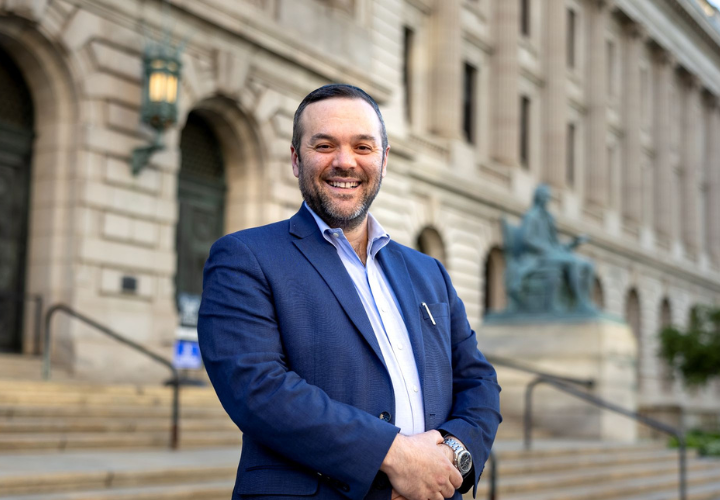




Daniel Grand is an Orthodox Jew who lived in University Heights, Ohio. His faith calls him to pray with a group of at least ten men on the Sabbath, a gathering called a minyan. He cannot drive on those days, so he needs friends who live close enough to walk. He emailed about a dozen neighbors and invited them to pray at his home.
One neighbor saw the email and complained to the mayor. The same day, before the group had met even once, the city sent Daniel a cease-and-desist order. It accused him of running an illegal “place of religious assembly” and told him he needed a special permit, the same kind the city requires of actual synagogues and churches.
Daniel tried to cooperate and started the permit process. Partway through, the city changed the rules of his hearing without warning. Then he discovered something that made the permit pointless: it would likely have made it illegal for anyone to live in the house. To host a prayer group in his home, he would likely have had to move out of it. And since Daniel never needed a permit to begin with and didn’t want to go through another hostile hearing, he withdrew the unnecessary application.
Instead of letting it go, the city went after him. Officials kept the order in force, urged his neighbors to watch his home and report him, and sent police to patrol his street. The city withheld his certificate of occupancy and his tax breaks, costing him thousands in additional taxes, and even skipped his house on trash day. The city moved the moment it learned the gathering was religious.
Daniel sued in federal court, but the lower courts never decided whether the city had violated his rights. They dismissed his case because he had not finished the city’s permit process. Daniel appealed to the Supreme Court, which agreed to hear his case. Alliance Defending Freedom is co-counsel on the case along with Orrick, Herrington & Sutcliffe LLP, and the Court will hear oral argument on December 9.
The Supreme Court is not yet ruling on whether University Heights violated Daniel’s rights. The question before the justices is narrower, but it still carries widespread impact. The lower courts said Daniel could not even bring his claims until he had finished the city’s permit process, the same process the city was using to stop him from praying at home with friends. The Court will decide whether a citizen must complete a process like that before he is allowed to challenge it in court, or whether he can go straight to court when the government burdens his religious exercise.
That sounds technical, but the effect is not. If a person has to exhaust a lengthy permit process before any court will hear him, a city can keep him tied up in that process indefinitely and never be held accountable. The First Amendment protects against this kind of chilling effect, where the mere threat of government penalty pressures people to abandon protected religious exercise. As soon as religious liberty is burdened, people like Daniel should have their day in court. They should not be made to suffer indefinitely.
The outcome of Daniel’s case will shape whether Americans can defend their freedom to exercise religion before the harm is compounded further.
In that same city, a neighbor could host a poker night, a Super Bowl party, or a birthday party for the same dozen people, in the same living room, and never need a permit. Only the prayer group was treated as a problem. The gathering was not too loud or too crowded. It was simply religious, and that was enough for the city to try to shut it down.
It would be easy to read this as a strange story about one man far away. It is not. Think about where much of your church’s life happens. Not only on Sunday morning, but in the Tuesday night small group in someone’s living room, the women’s Bible study over coffee, and the men who gather to pray after work. These are the spaces where people come to faith and carry each other through the hardest seasons of their lives.
If this can happen to a Jewish man praying in Ohio, it can happen to a Bible study, a prayer meeting, or a small group in any city in America. The freedom that protects Daniel’s living room protects yours.
Christians have always gathered in homes to pray. From the beginning, believers met in one another’s houses to break bread, study Scripture, and pray together (Acts 2:46). Paul sent greetings to those who gathered in the homes of Priscilla and Aquila, of Nympha, of Philemon. For much of Christian history, and in many countries today where the faith is pressured, the home has been an ordinary place where believers gather to pray and encourage one another.
That is still true in your church. The small group, the Bible study, the prayer meeting, and the discipleship that happens around a kitchen table are not extras. They are where faith is formed. When a city treats a home prayer gathering as something it can shut down, it reaches the very heart of how God’s people live out their faith together.
Why are we, as Christians, praying for a Jewish man’s case?
Because the freedom he is fighting for is ours too. The right to gather and pray in our own homes belongs to every American. If a city can force Daniel Grand’s prayer group to seek a permit that it can then deny, it can do the same to a Bible study tomorrow. Standing with him is how we stand up for all of us.
Does this mean churches no longer need permits?
No. This case is only about praying with friends in a private home. It does not change anything about how permits or zoning work for church buildings. Daniel was never running a synagogue. He was hosting a prayer group in his bonus room.
Isn’t this just a normal zoning dispute?
No. There were no complaints about noise or traffic, and the group never even met. The city acted the instant it learned the gathering was religious. That is not zoning enforcement. That is singling out prayer.
In response to Daniel’s case, churches across the country are doing the very thing his city tried to stop: gathering their small groups to pray at home. Alliance Defending Freedom is launching a nationwide prayer effort leading up to December 9, called #PrayFreely.
Groups pray in their homes through the weeks before the case, and then everyone prays together the morning the Court hears oral arguments.
You do not need to be a legal expert to lead your people in this. Everything is ready for you to use however best fits your church:
A plain-language briefing for pastors on the Grand v. University Heights case: what happened, what the Supreme Court will hear on December 9, and why it matters for your church


